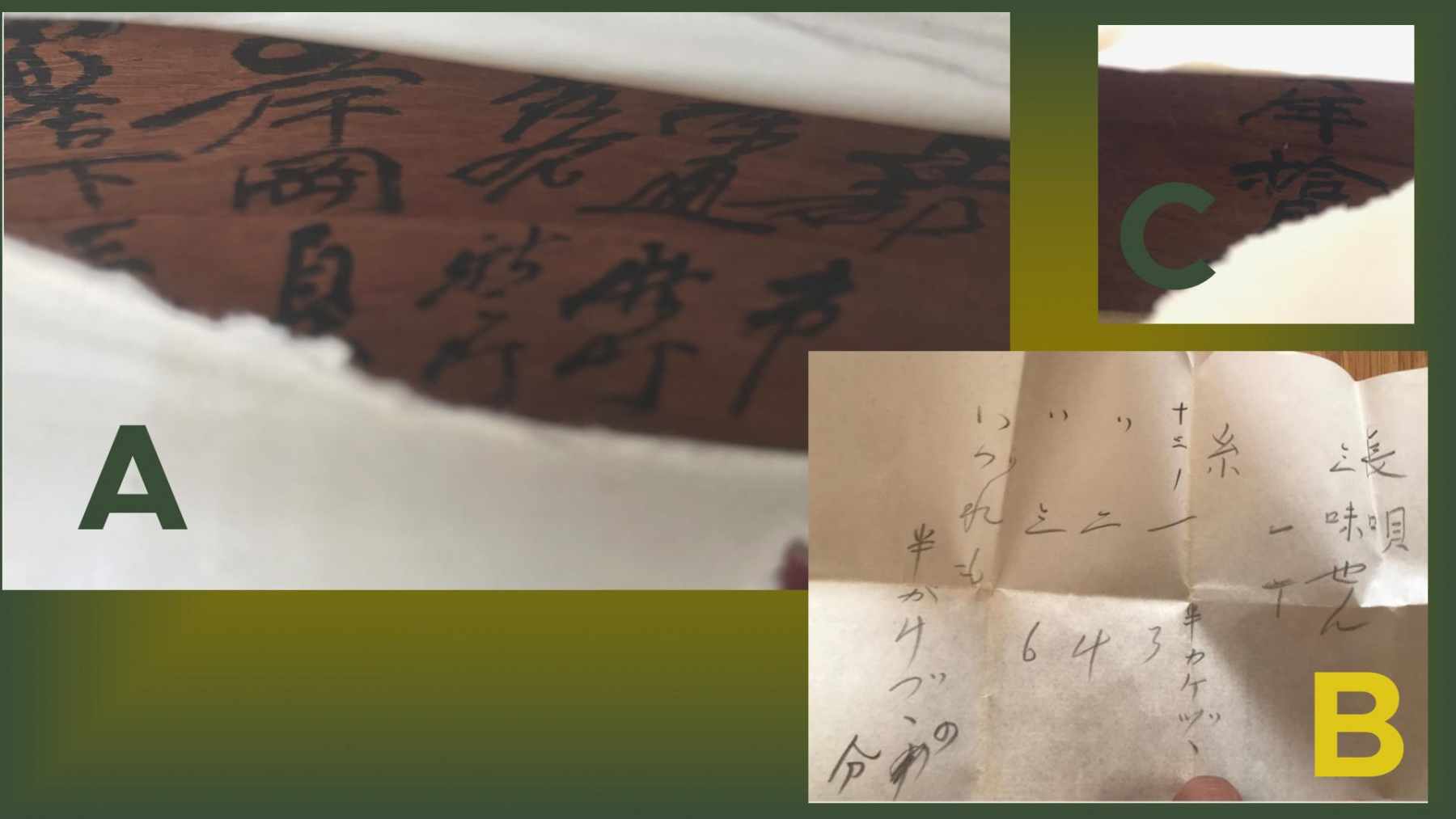
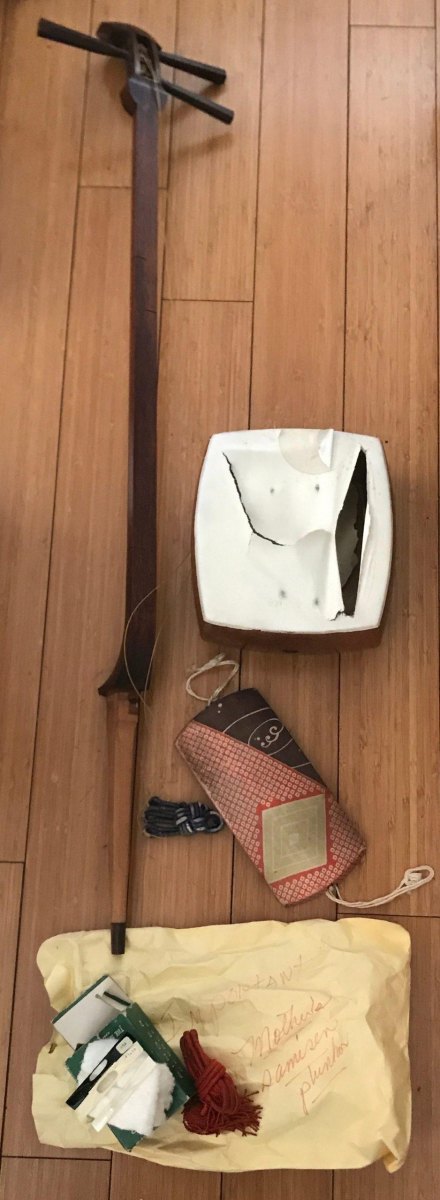
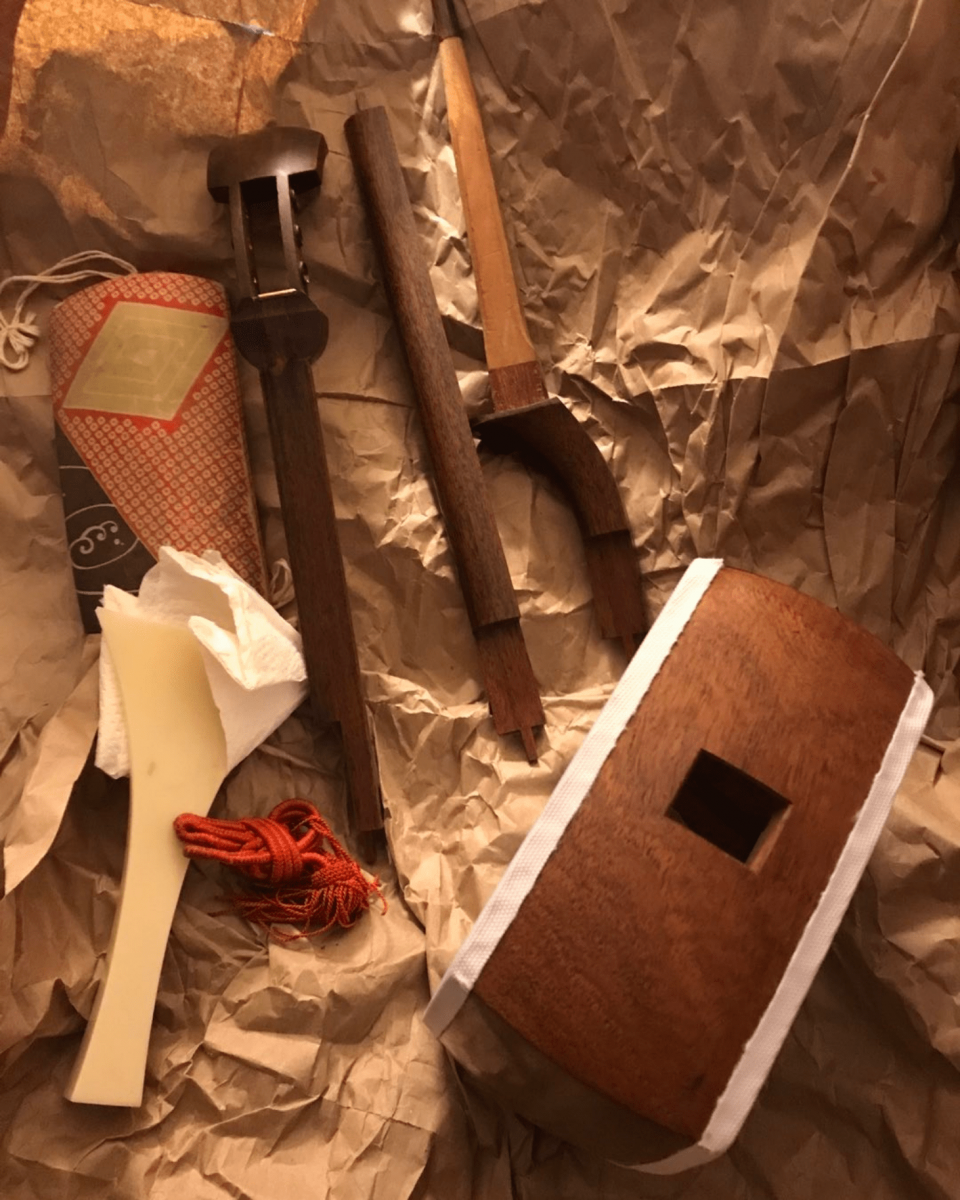
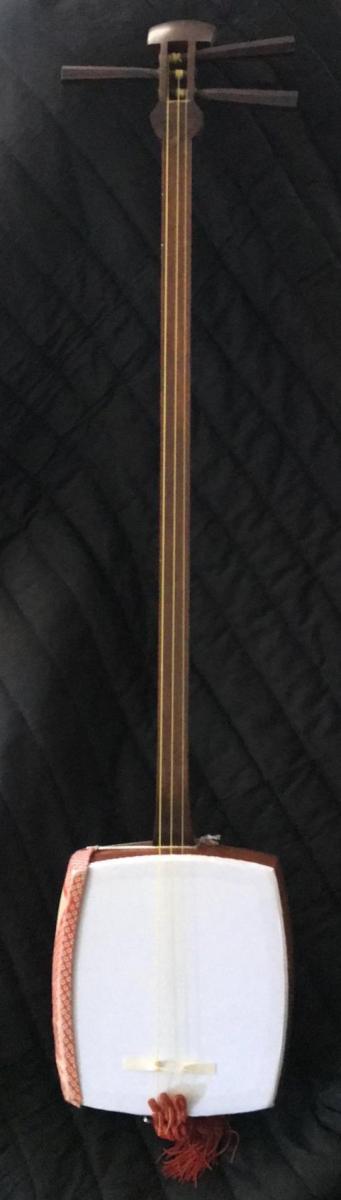
Grandma, Fujiko Kobayshi Ebihara, brought her nagauta samisen (三味線) to the U.S. with three young kids on the two-week boat trip from Japan, not long before the Great Kanto Earthquake of 1923. I don’t think she even had a hard case for it. I assume she had it disassembled for the trip. This is back when they were using cat gut for the skin of the body and silk strings. I have to follow-through with research of the probably songs she had learned when she was a teen, and as an aficionado of Kabuki. The music at the bottom of the post is just a timestamp of where my technical facilities are right now, bad habits and all.
My mother, Emiko, the second daughter who became 2nd oldest sibling after her eldest brother and sister and sister died early pre-WWII, did a series of paintings of her mother along with some descriptions and backstory connected to each one (in quotes below). Here’s a few of these paintings that give partial context to the history of this instrument’s journey.
FATAL DECISION
In 1923, Fujiko finally received a hoped-for letter from her husband, Shiro Ebihara, from the U.S. after almost a 3-year absence. He came to the U.S. in 1921 under the sponsorship of some of the early industrialists in Japan to further his skills in tool and diemaking, etc., for one year in the East with Brown and Sharp in Pennsylvania. He left his tool and die factory in Tokyo in a partner’s hands for that presumed one year. Fujiko had four children from this marriage and one had died during his absence. Because of his unexpected long absence, Shiro was disowned by Fujiko’s family as well as his family and could not return to Japan. Fujiko endured the years of absence clinging onto the hope that she might one day hear from him. What an incredible belief and faith she kept toward Shiro!!! Shiro’s letter was about her joining him with the remaining three children with barely enough to cover the expenses for traveling on ship to the U.S.”


BLIND HOPE
“Dressed in her elegant and understated hand-woven silk jacquard kimono of navy, she arrived to San Francisco with her precious three children and absolute minimum of baggage, her favorite instrument, the shamisen, that she was well-trained in from childhood, a samurai pearl crest that belonged to her half-sister’s husband’s father. The children were Yaeko, 8 yrs., Rokuo, 6 yrs. and Hiroshi, 2 yrs. She arrived with no pictures of her relatives. I wondered if that was because of being disowned by her wealthy relatives.”

CONSOLATION AND SURVIVAL TO OVERCOME
“Two years after Yaeko’s death, the next oldest child, Rokuo, died of kidney ailment at age 18. Rokuo was highly revered in this small town of Clovis as a rarely gifted academic student and graduated with high honors at age 15 from high school. He died while awaiting to be accepted in a law school in St. Louis, MO. I cannot imagine the heavy toll it took on my mother’s sorrows of the two heavy losses of such bright and intelligent children.”
By day, obaachan’s (Japanese word for grandmother) gig was doing the manual labor of cleaning machine oil out of Japanese American railroad laborers who lived on the Santa Fe railroad property complex in Clovis, NM. After cooking dinner and putting the kids to sleep, my mom said the only time a smile would appear on her face was when she sat down to play her samisen, which went on to the survive concentration camp in Topaz, AZ, and relocation post-war to Cleveland. I believe my mom took possession of it when my maternal grandparents moved from Cleveland to Boyle Heights, CA in the late 1970’s. My mom used to keep it on display in a vertical clear plexiglass case and all I did was look at it with it’s broken skin for years. To be privileged to inherit it, and begin to play it (clumsily) has been a deeply personal journey that is hard to express in words.
The instruments was reskinned in 2022 by Kyle Abbott in Santa Cruz with synthetic skin. Fortunately the neck remained straight and playable. In addition like most samisen players today, I now use synthetic strings. The synthetic materials make it sound much brighter than the materials used in the old days. I hope to experiment with a “fiber” skin in the future to perhaps mitigate what I feel is the “over-brightness” of the tone.
Aside from a still-mediocre technique, I hope to learn more of the old songs she may have liked and moreso ground my playing in traditional musical language. At the same time, I have to be true to who I am as someone growing up as a third-generation Japanese American not versed in the language of my Issei grandparents (first generation, immigrants). The sensibilities I’ve grown up with and studied as someone primarily out of the African American musical diaspora can’t just be tossed aside for the sake of adherence to strict classical Japanese songs only.
As bad as my technique is and with paltry knowledge of the classic repertoire, the unique timbre of the instruments survives this player and no matter what, this sound reconnects to the old spirits.
I can’t imagine obaachan would “approve” of the aural butcherings I am creating with her precious instrument, but maybe she’ll forgive me for at least making an attempt to connect to her spirit and the impulses that brought her joy via this family heirloom. Recording from July 18, 2026:
Click on the images below to see the full photo.